How to tell gentoo from Magellanic penguins on Martillo Island
Two penguins nest on Martillo Island, and a third drops in now and then. From the beach or from a boat, a few clues tell gentoos and Magellanic penguins apart. This guide covers both and the rare king, then the other wildlife on the Beagle Channel.
Two species share the island
Martillo Island is home to gentoo and Magellanic penguins. They nest side by side on the same small island in the Beagle Channel, so a visit in the right weeks usually shows you both.
At first glance the two look alike, black backs over white fronts. The differences sit in the head and chest, which is where the next sections point your eyes.
Locals call the island Isla Martillo or simply Penguin Island. Whichever tour you take, these two are the birds you come for, and a third species appears only as a rare visitor.
Gentoo penguins and the orange bill
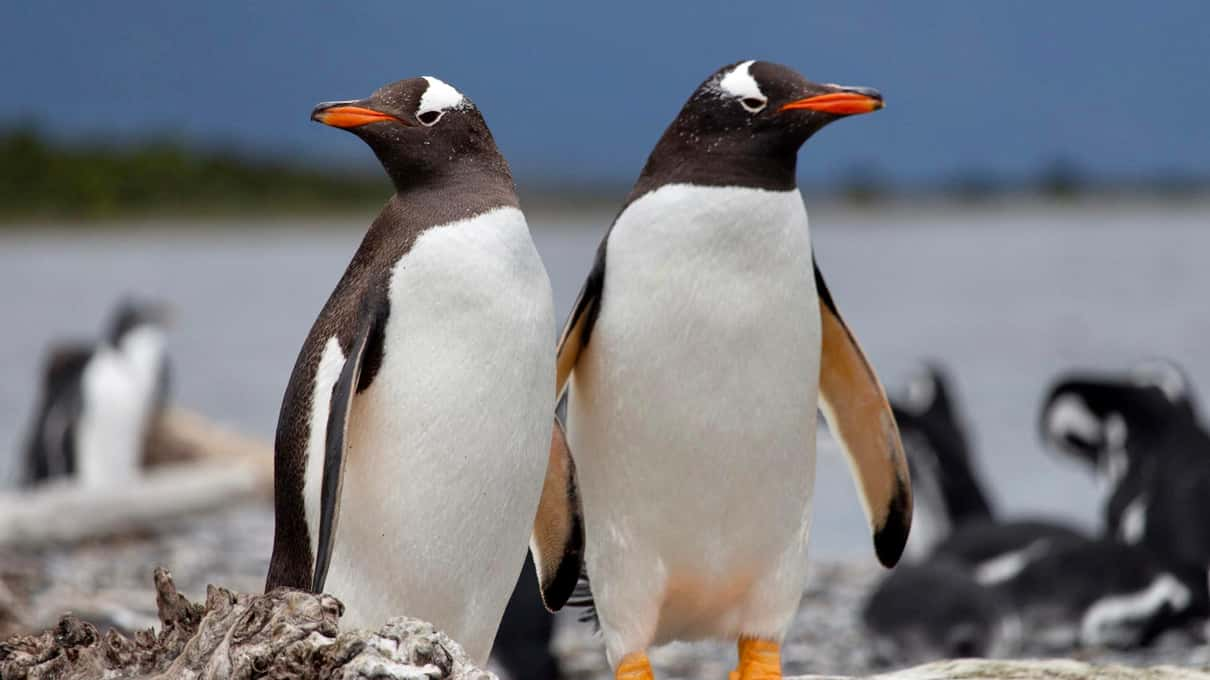
The gentoo penguin is the easier one to name. Look for a bill in bright orange-red and white marks above the eyes, both visible from a fair distance.
Gentoos stay around Martillo Island all year, according to Explore Tierra del Fuego's listing. You often see them coming out of the shallows onto the pebbles, which makes good watching from a boat.
Magellanic penguins and the black bands
The Magellanic penguin has a dark bill and two black bands across a white chest. A white stripe curves from above the eye down around the dark face.
Magellanic penguins nest in burrows dug into the soft ground, so in season many stand by holes on the grassy slope. The same listing has them at the colony from about October to March. They spend the colder months at sea.
That timing matters when you plan. Our guide to the best time to go explains which weeks give you both species at once.
Telling them apart from a boat
From the deck you are farther away than on the walk. Go by colour and shape rather than fine detail, with these clues that work at a distance.
- An orange-red bill means gentoo; a dark bill means Magellanic
- A white patch above the eye points to a gentoo
- Black bands across the chest point to a Magellanic
- Birds standing at burrow entrances on the grass are usually Magellanic
Binoculars help a lot, and a phone with a zoom covers the rest. Explore Tierra del Fuego's small boat from ~$150 works nearer the shore than the big boats, which makes the comparison easier.
Close to the shore in a small boat
Explore Tierra del Fuego takes up to 15 people from Puerto Almanza to watch the gentoos and Magellanic penguins. A naturalist guide comes along, and the boat provides a hot drink and warm clothes.
The odd king penguin
A king penguin turns up on Martillo Island now and then. One reviewer on the small boat from Puerto Almanza counted three species on a single trip, a king among them.
Treat that as luck. No tour can promise one, and the kings on this island are occasional visitors rather than a colony you can count on.
What the birds get up to
Watch the shoreline for a while and patterns appear. Gentoos often arrive from the water in small groups, while Magellanic penguins stand near their burrows or walk slowly up the slope.
Magellanic penguins are known for a loud braying call, a little like a donkey. If the boat goes quiet on a calm day, you may hear one before you spot it.
Around the middle of the season there are usually chicks. Young penguins are grey and fluffy before they grow adult feathers, so a ball of down beside an adult is a chick, not a third species.
Penguins in the water swim fast and low, sometimes leaping clear of the surface. From a boat you may see a line of small splashes heading for the beach before the birds land.
Other wildlife on the routes
The penguins share the channel with plenty of other animals. The catamaran from Ushuaia passes Sea Lion Island, where South American sea lions haul out. It also rounds Les Eclaireurs lighthouse, whose rocks hold imperial and rock cormorants.
The cormorants are easy to sort too. Imperial cormorants have white fronts and stand in packed rows, while rock cormorants are darker and often nest on narrow ledges.
Skuas patrol near the colonies, and black-browed albatross are possible over open water. Dolphins circled one reviewer's boat on the walking tour, and a catamaran passenger saw whales on an autumn trip.
None of these are guaranteed. Wildlife on the Beagle Channel follows the wind and the season rather than the timetable.
Which tour suits a wildlife day
Canoero's catamaran at ~$230 covers the most wildlife beyond penguins, since its route passes the bird and sea lion islands. Azul Latina's walk at ~$530 puts you closest to both species, on foot for about an hour.
The small boat is the quietest, with up to 15 people and a naturalist guide. Our walk-or-boat guide compares the three in detail.
Whichever you choose, bring binoculars if you own a pair. On the boat tours they turn a row of dark shapes into two different birds.
For the hour on the island itself, read what the walk is like. The Puerto Almanza guide follows the small-boat route from the van ride to the colony.